
RFQ and inquiry, Whatsapp +86-18665819835 or email : sales@xinspower.com
Get more insights into industry https://www.xinspowertech.com/news.html
Date: October 09, 2026
Scope: Global market and China market
Intended for: industry practitioners, investors and supply-chain decision-makers
Executive Summary
In 2026, the global power adapter industry stands at a critical juncture of generational technology transition and market-structure realignment.Driven simultaneously by the accelerating commercialisation of third-generation semiconductors (GaN/SiC), continuously tightening global energy-efficiency regulations, the advancing unification of the USB-C interface, and the explosion of emerging applications such as AI computing and new-energy vehicles, the industry is undergoing a profound transformation from "conventional silicon-based switching power supplies" toward "high power density, wide-bandgap semiconductors, intelligence and multi-scenario integration".
Market size.Based on an aggregation of data from multiple research institutions, the global power adapter market is expected to reach approximately US$52 billion in 2026, up about 7.2% year on year; China’s market is about US$18.2 billion, accounting for a 35% global share and retaining its position as the world’s largest producer and consumer[2][1]. In terms of shipments, global power adapter shipments are expected to exceed 1.8 billion units in 2026, with a compound annual growth rate of around 6%[2].
Technology trends.GaN (gallium nitride) has become the most transformative force in consumer fast charging. In 2026 the global GaN fast-charging market is worth about US$4.85 billion, with penetration in consumer fast chargers rising to roughly 35%[4][3]. The rollout of the USB PD 3.1 standard (up to 240 W) is pushing single-device charging power from 65 W toward 140 W and even 240 W[9]. SiC (silicon carbide), meanwhile, is accelerating into high-voltage, high-power scenarios such as on-board chargers, data-centre server power supplies and charging piles[20].
Competitive landscape.Industry concentration continues to rise, with the world’s top five manufacturers together holding about 38%–45% of the market; leading players build barriers through vertically integrated supply chains and R&D investment[2][15]. Domestic leaders represented by Aohai Technology are actively extending into high-growth tracks such as AI-computing power supplies and new-energy-vehicle electronic controls[19]. On the policy front, the EU’s new ErP energy-efficiency rules came fully into effect in September 2026, and China’s new GB 20943-2025 energy-efficiency standard will take effect in February 2027, continuously forcing product upgrades[11][5].
Key conclusion: Over the next three to five years, the industry’s growth drivers will shift from "replacement demand in traditional consumer electronics" to a trio of engines — rising GaN fast-charging penetration, explosive demand from emerging scenarios such as data centres, new-energy vehicles and IoT, and a maturing wireless-charging ecosystem. Companies with wide-bandgap semiconductor R&D capabilities, a global certification footprint and multi-scenario solution capabilities will gain significant competitive advantage.
1. Industry Overview and Global Market Size
1.1 Industry Definition and Development Stages
A power adapter is an external power supply unit that converts AC mains electricity into low-voltage DC power to deliver a stable energy supply to electronic devices. It is used in virtually every electricity-consuming field, including consumer electronics, industrial equipment, communications base stations, new-energy vehicles and medical instruments.
The industry has broadly gone through three stages: the era of conventional linear power supplies (low conversion efficiency, bulky size); the widespread adoption of switching power supplies (efficiency greatly improved to above 80%); and the current evolving period of wide-bandgap semiconductor application. The large-scale adoption of third-generation semiconductor materials (GaN/SiC) is pushing power adapters into a new stage of "high frequency, miniaturisation, high power density and intelligence"[1][7].
1.2 Global and China Market Size
The global market keeps growing steadily.According to aggregated estimates from multiple industry research institutions, the global power adapter market was worth about US$48.5 billion in 2025 and is expected to reach US$52 billion in 2026, up about 7.2% year on year; by 2028 the global market is expected to exceed US$60 billion, implying a compound annual growth rate (CAGR) of about 7.6% over 2025–2028[2]. In terms of shipments, global power adapter shipments are expected to reach 1.8 billion units in 2026, up about 6% year on year[2].
China holds a central position.China is the world’s largest producer and consumer of power adapters. Its market is expected to be about US$18.2 billion in 2026, roughly 35% of the global total, growing slightly faster than the global average. Leveraging a complete industrial-chain ecosystem, China accounts for about 60%–65% of global production capacity, and its power adapter exports represent about 65% of total global exports[2][1].
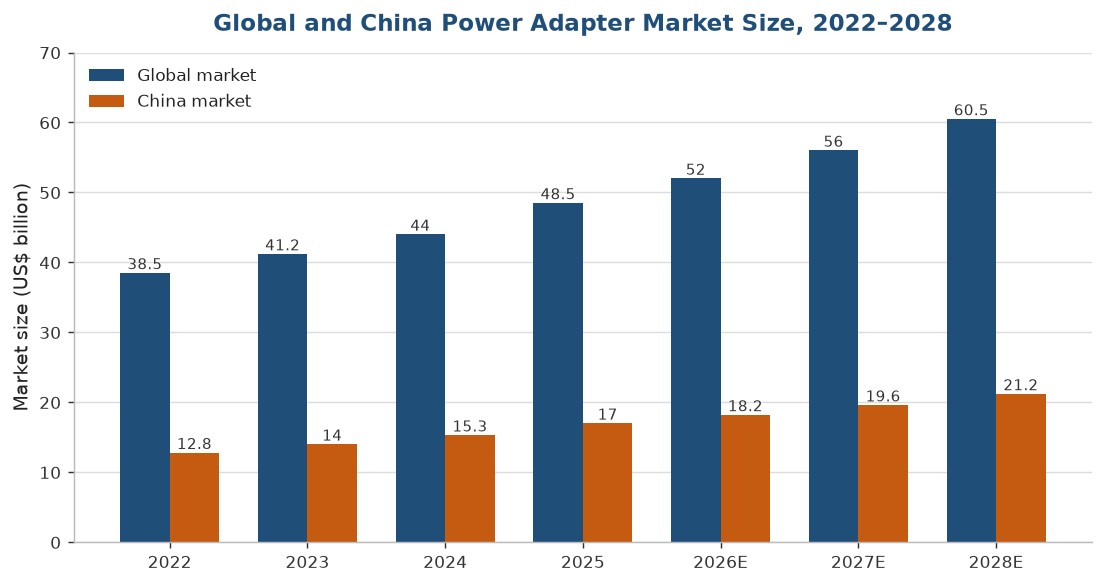
Figure 1: Global and China power adapter market size, 2022–2028 (Source: compiled from IIM, Industry World and other institutional data)
1.3 Regional Market Landscape
In terms of regional distribution, Asia-Pacific is the core growth engine of the global power adapter market, with a market share of about 45% in 2026, mainly benefiting from China’s complete industrial-chain cluster and the demographic dividend and accelerating digital-infrastructure build-out in Southeast and South Asia; the region’s average annual growth rate reaches 8.5%[2][1]. North America accounts for about 26%; driven by cloud computing and AI data-centre construction, its demand for server power and high-performance-computing power supplies remains high and stable. Europe accounts for about 19% and, driven by strict energy-efficiency regulations, is shifting toward higher-value-added, low-carbon products[1].
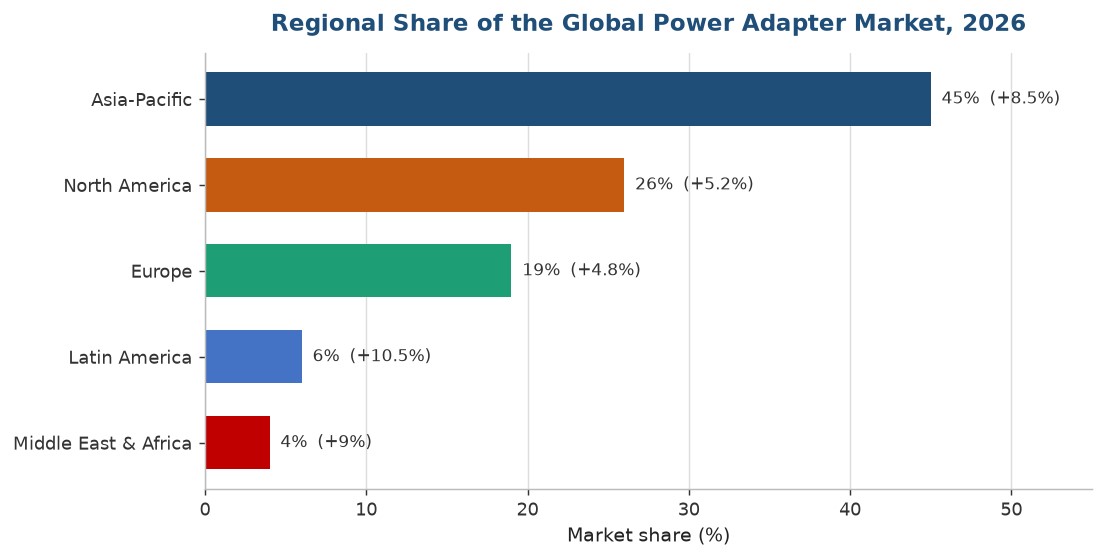
Figure 2: Regional share of the global power adapter market, 2026 (Source: compiled from industry research institutions' data)
2. Core Technology Evolution Trends
2.1 Wide-Bandgap Semiconductors Reshaping Product Form
Wide-bandgap semiconductor materials represented by GaN (gallium nitride) and SiC (silicon carbide) are fundamentally reshaping the design logic and product form of power adapters. At the same withstand voltage and on-resistance, the gate charge (Qg) and output charge (Qoss) of GaN devices are only one-tenth of silicon devices or even lower, and switching frequency can be raised to the MHz level, reducing the volume of magnetic components (inductors and transformers) by more than 40% and cutting switching losses by 40%, greatly shrinking volume at the same power level[14].
Market penetration is accelerating. In 2026 the global GaN fast-charging market is worth about US$4.85 billion, up about 18% year on year, and GaN fast-charging chip shipments are expected to exceed 1.2 billion units, up about 22% year on year[4]. In consumer fast-charging adapters, GaN penetration has risen from 8% in 2022 to about 35% in 2026 and is expected to exceed 50% by 2028[4][1]. Among these, 65 W–100 W single-port GaN wall chargers form the industry’s base, while 120 W–240 W multi-port desktop chargers have become the core high-growth track, with a segment CAGR of 21.3% expected over 2026–2032[3].
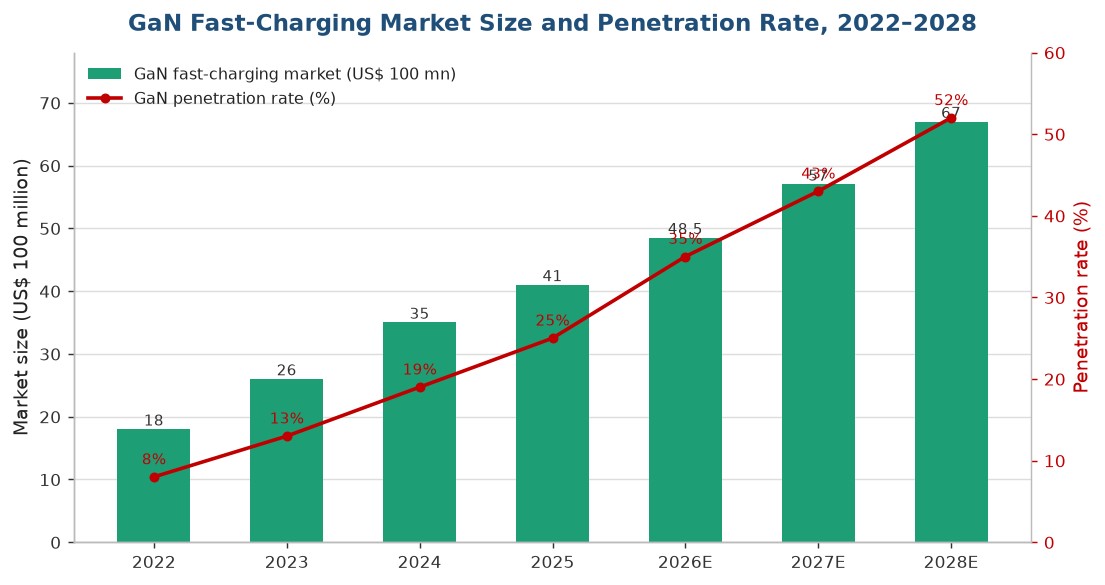
Figure 3: GaN fast-charging market size and penetration rate, 2022–2028 (Source: IIM, Gongyan Industry Research Institute)
SiC (silicon carbide) dominates high-voltage, high-power scenarios. SiC MOSFETs show major advantages in on-board chargers (OBCs), DC fast-charging piles and data-centre server power supplies. In 2026, SiC penetration in OBCs is expected to rise above 35%; in 800 V high-voltage platform vehicles in particular, it can raise charging efficiency to above 98%[20]. As 6-inch wafer production becomes widespread, SiC device costs are falling at an annual rate of 10%–15%, and the economic inflection point is emerging[20].
2.2 USB PD 3.1 and Higher Power
The USB PD 3.1 standard was released by the USB-IF in 2021, raising the maximum power from 100 W in PD 3.0 to 240 W and adding three fixed-voltage levels (28 V, 36 V and 48 V) together with the AVS adjustable-voltage mechanism, providing a universal charging solution for high-performance notebooks, portable monitors, gaming devices and even small power tools[9]. By early 2025, more than 110 devices supported PD 3.1 fast charging, spanning nine major categories including chargers, power banks and docking stations[10]. In 2026, the share of power adapter products supporting PD 3.1 and above is expected to reach 50%–78%[1][2].
In terms of topology, the buck-boost topology is deeply integrated with the PD protocol, using wide-voltage adaptation and intelligent power scheduling to increase power 2–3 times at the same volume, or to reduce volume by more than 40% at the same power[6]. Amid the trend toward GaN IC integration, monolithic integration of driver circuits, protection circuits and power devices (GaN IC) is becoming the next-generation technology direction, greatly simplifying PCB layout, reducing parasitic parameters and improving reliability[18].
2.3 A Maturing Wireless-Charging Ecosystem
As an important complement to wired charging, wireless charging is accelerating its penetration from high-end flagships to mass-market products. The WPC launched the Qi2 standard at the end of 2023, incorporating magnetic alignment; in December 2024 it released the Qi2.2 standard (Qi2 25W), raising the wireless-charging power ceiling to 25 W and introducing strict thermal-performance specifications[12].
In 2026 the global Qi wireless-charging market is expected to reach RMB 75.45 billion (about US$10.5 billion), up about 7.9% year on year, and is expected to grow to RMB 112.7 billion by 2032, a CAGR of 6.9% over 2026–2032[13]. By the end of 2025, more than 13,000 products worldwide had obtained Qi certification, including over 2,600 Qi2-certified products[12]. Magnetic power banks, in-car magnetic mounts and all-in-one charging bases have become high-growth categories.
2.4 Digitalisation and Intelligence
DSP-based digital power-control technology is moving down from high-end medical and industrial fields to the consumer market, achieving voltage-regulation accuracy better than 0.5% under dynamic loads and supporting real-time ripple monitoring, adaptive calibration and intelligent power allocation[7]. Intelligent dynamic power-allocation algorithms can identify in real time the number of connected devices, their power requirements and fast-charging protocols, dynamically allocate output power and solve the power-attenuation problem when multiple ports are used simultaneously[18]. By 2030, smart power adapters with remote monitoring and fault-warning functions are expected to see large-scale adoption, further extending the product value chain[2].
3. Policy Environment and Upgrading Energy-Efficiency Standards
3.1 Efficiency Regulations Continue to Tighten Worldwide
Rising efficiency standards are an important external force driving the industry’s technological upgrading. In September 2026, the EU’s new ErP (Energy-related Products) Directive came fully into force, including supporting regulations such as (EU) 2025/2052, imposing stricter requirements on the no-load power consumption and energy-conversion efficiency of power adapters: phone chargers (including PD fast chargers) must achieve an average efficiency of ≥89% (at 25% load) with no-load power consumption ≤0.1 W; all new batches of exported products must use the new EN IEC 62301:2024 test standard and be registered in the EPREL database with a unique QR-code label[11]. The CE mark is only the safety-access basis; ErP efficiency compliance has become an independent mandatory item, requiring companies to complete a series of processes including technical-document archiving, EPREL registration and label-compliance review[11].
China’s new energy-efficiency standard GB 20943-2025, "Minimum allowable values of energy efficiency and energy efficiency grades for AC-DC and AC-AC power supplies", was issued in January 2025 and is scheduled to take effect on 1 February 2027, replacing the GB 20943-2013 version that had been in force for more than a decade[5]. The standard expands its scope to server embedded power supplies with a rated output power of ≤27.5 kW, integrates experience from GaN applications, upgrades from partially recommended to fully mandatory implementation, and aligns its test methods with the EU CoC and US DoE standards[5]. At the same time, major markets worldwide generally require standby power consumption below 0.1 W as a market-access threshold, and the proportion of 80 PLUS Titanium and above certifications in high-end power supplies has risen significantly[2].
3.2 USB-C Interface Unification
Interface unification is turning from a policy trend into market reality. The EU requires that from 28 December 2024, portable devices such as phones, tablets, cameras and headphones must use a unified USB-C interface; from 28 April 2026, laptops are also included in the mandatory scope. Apple’s full switch to USB-C starting with the iPhone 15 series marks a key step toward unified consumer-electronics interfaces worldwide[17].
On 30 July 2026, China issued GB/T 32638-2026, "Technical requirements and test methods for power adapters and interfaces of mobile communication terminals" (a recommended standard), scheduled to take effect on 1 February 2027, to promote technical unification of mobile-terminal adapters and interfaces[17]. The direct impact of interface unification is: a decline in the number of charger purchasing SKUs, improved per-unit turnover efficiency and accelerated expansion of the universal PD fast-charging market; however, the fragmentation of fast-charging protocols (PD, QC, SCP, VOOC, UFCS and others coexisting) remains a practical issue the industry must address[16].
3.3 Environmental and Carbon-Footprint Requirements
The EU’s new Battery Regulation and Ecodesign Directive impose higher requirements on the repairability and recyclability of power adapters; by 2026, the penetration of adapters with modular design and easy-to-disassemble structures in the European market is expected to reach 40%[2]. Full-life-cycle carbon-footprint management of products has become a new compliance challenge for exporters. At the same time, safety-certification standards are also being upgraded: the EU’s EN 62368-1:2022+A11:2023 has become fully mandatory, the transition period for the third edition of UL 62368-1 in the US has ended, and the frequency of China’s CCC certification spot checks has increased by 40%[11]. In the short term, these regulatory changes raise companies’ compliance costs, but over the long term they will accelerate the exit of outdated capacity and raise the industry’s overall technical level and concentration.
4. Shifting Demand Structure in Downstream Applications
4.1 Consumer Electronics: Replacement Upgrades and Fast-Charging Penetration
Consumer electronics remains the largest downstream application of power adapters, accounting for about 42% of the overall market and covering smartphones, notebooks, tablets, TWS earphones and more[16]. Fast-charging power upgrades for phones and notebooks constitute rigid replacement demand — thin-and-light laptops, gaming laptops and flagship phones generally support high-power fast charging, and conventional bulky silicon adapters are being rapidly replaced by compact GaN solutions. The trend toward multiple devices per person is driving an explosion in demand for multi-port all-in-one chargers, with categories such as desktop charging stations and travel fast-charging kits growing rapidly. The replacement cycle for consumer-electronics adapters has shortened to 2–3 years[3][2].
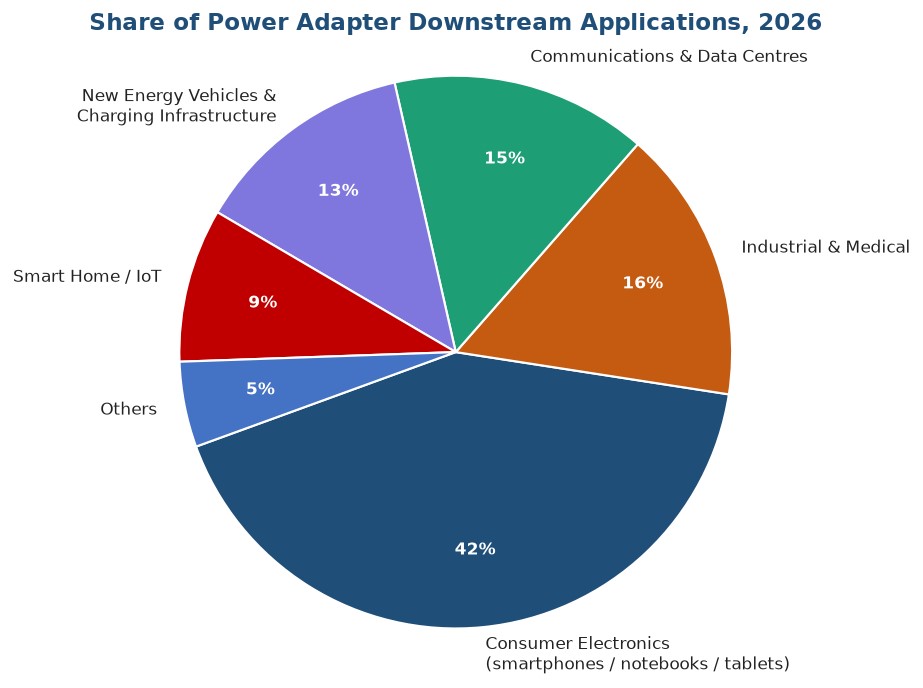
Figure 4: Share of power adapter downstream applications, 2026 (Source: compiled from East Money and industry research data)
4.2 Data Centres and AI Computing: An Explosive New Engine
AI-computing infrastructure is the fastest-growing emerging track for the power adapter industry. Driven by rising global AI-computing demand, GPU rack power density is evolving from the kilowatt level to the megawatt level (NVIDIA’s Rubin Ultra rack is expected to exceed 1 MW in 2027), and data-centre power architectures are shifting toward 800 V high-voltage DC (HVDC)[20][8]. The data-centre power market is expected to grow at a three-year CAGR of 75%, reaching US$33 billion by 2028[8]. GaN devices show significant efficiency advantages in the three-stage step-down chain of 800 V → 54 V → 12 V → chip voltage, with the number of GaN devices per board reaching the thousand level, bringing enormous incremental space for power-semiconductor companies[20]. Domestic power leaders represented by Aohai Technology have made server power a strategic business, covering 550 W to 8,000 W[19].
4.3 New Energy Vehicles and Charging Infrastructure
The new-energy-vehicle industry has opened up a completely new space for the power industry. GaN and SiC power devices are accelerating their penetration into on-board chargers (OBCs), high/low-voltage DC-DC converters, in-car wireless charging and DC fast-charging piles. GaN can raise OBC power density to above 6 kW/L, push system efficiency above 96% and reduce module volume by about 40%[20]. Leading domestic power companies such as Aohai Technology have achieved rapid growth in new-energy-vehicle power and electronic-control business, which generated revenue of RMB 1.144 billion in 2025, up 106.6% year on year, with cumulative supply of more than 2 million units[19].
4.4 Industrial, Medical and IoT: A Steadily Growing Blue Ocean
Industrial-grade power adapters benefit from smart manufacturing, industrial automation and the expansion of the robotics industry, with growth expected at 8.5%; medical power supplies have strict requirements for ultra-low leakage current and high reliability, and their gross margins and customer stickiness are significantly higher than those in consumer electronics[2][15]. The explosive growth of IoT terminal devices brings massive demand for miniaturised, low-power adapters; long-tail scenarios such as smart homes, wearables and security surveillance are becoming new growth points, and IoT-related power demand is expected to increase by 15% per year over 2026–2030[2]. The market share of non-traditional consumer-electronics power adapters is expected to exceed 30% in 2026[1].
5. Competitive Landscape and Value-Chain Analysis
5.1 Rising Industry Concentration
The power adapter industry presents a competitive landscape of "concentrated leaders with a long tail". The world’s top five manufacturers together hold about 38%–45% of the market and the top ten about 55%–60%, with both trending upward year by year[2][1]. Leading players build competitive moats through vertically integrated supply chains (extending upstream to magnetic components and chip manufacturing), sustained high R&D investment (leading players’ R&D spending averages 6.5% of sales) and a global certification footprint[2]. SMEs face considerable survival pressure and are being forced into niche markets (such as medical-specific, security POE power and aerospace-grade modules) or to seek M&A consolidation.
5.2 Leading Competitor Tiers
The industry’s core participants in 2026 can be divided into three strategic camps[15]:
· Platform-level ecosystem players: represented by listed companies such as Delta Electronics, Lite-On Technology, Keli Ke, Aohai Technology and BYD Electronic, with annual revenues in the billions to tens of billions of RMB and monthly capacity at the tens-of-millions level, mainly serving the world’s top phone and notebook brands as well as server and NEV manufacturers, and known for extreme automation and supply-chain integration capabilities. Delta Electronics is the global leader in switching power supplies; Aohai Technology, a "national manufacturing champion", posted revenue of RMB 7.154 billion in 2025 and is transforming from conventional chargers toward AI-computing power, NEV electronic control and digital energy[19]
· Hidden champions in niche tracks: focused on specific fields such as security power, medical power, POE power or industrial drives, with gross margins and customer stickiness above the industry average. For example, MEAN WELL covers diverse scenarios in standard industrial power with more than 10,000 standardised products; Huntkey has brand advantages in PC power and consumer adapters[2]
· Highly resilient custom manufacturers: represented by mid-sized specialist firms in Shenzhen and its surroundings (such as Xingucheng Technology and UE Electronic), whose core competitiveness lies in their own industrial parks, full power-range coverage (5 W–420 W), a ten-item global certification matrix (CCC/UL/CE/GS/PSE/KC and more) and rapid customisation response capability; they are important recipients of medium-volume, highly customised orders[15][18]
· Emerging consumer brands: brands such as Anker, UGREEN and Baseus excel in product design, multi-protocol compatibility and channel operations in the C-end market and have risen rapidly amid the wave of GaN fast-charging adoption.
5.3 Value-Chain Structure and Cost Trends
Upstream in the power adapter value chain are semiconductor devices (power ICs, GaN/SiC devices, protocol chips), magnetic components (transformers, inductors), passive components (capacitors, resistors) and structural parts (housings, heat sinks, cables); the midstream covers design, production and assembly; and the downstream spans terminal fields such as consumer electronics, communications, new energy, and industrial and medical applications[16].
On cost and supply chain: metal materials such as copper and aluminium saw volatile upward prices in 2025–2026, raising production costs by about 5%–8%[1]. Leading players offset cost pressure through vertical integration and smart manufacturing — the proportion of smart-manufacturing plants in the industry is expected to reach 40% in 2026, and AI quality inspection and automated production lines raise yield rates above 99.5%[1]. In the protocol-chip field, domestic substitution has made notable progress: Injoinic and Smartlink together account for 68% of the PD 3.1 protocol-chip market, marking an important breakthrough by Chinese companies in the core chips of fast charging[10].
The trend toward regionalised supply-chain restructuring is clear. Affected by geopolitics and trade barriers, some capacity is shifting to near-shore regions such as Mexico, Eastern Europe and Southeast Asia to shorten delivery cycles and avoid tariff risks; however, with its most complete industrial cluster and fastest response speed, China will remain the global power-manufacturing centre in the medium and long term[2].
6. Outlook and Strategic Recommendations
6.1 Five Core Trends
· High power density and miniaturisation: GaN/SiC wide-bandgap materials will continue to drive power-density improvements, aiming for greater power output in a smaller volume. In 2026 flagship products generally achieve conversion efficiency of 92%–95%, and system-level efficiency above 98% is expected within three years[7]
· All-scenario integration and multi-protocol compatibility: USB-C unification is making "one charger for everything" the mainstream, with multi-port intelligent power allocation, UFCS converged fast charging and full-protocol compatibility becoming standard, greatly reducing the burden of carrying multiple adapters[18]
· Dual engines of AI computing and new energy: high-power, high-value scenarios such as data-centre HVDC power supplies, on-board OBC/DC-DC and charging piles will become the fastest-growing tracks, with power companies transforming from "consumer-electronics accessories suppliers" into "efficient energy-application solution providers"[20][19]
· Wireless charging and contactless power: the Qi2 magnetic standard unifies the ecosystem, and multi-device wireless chargers, in-car embedded and furniture-integrated wireless charging will move from standalone accessories to infrastructure, forming a market structure in which wired fast charging and wireless top-up complement each other[13]
· Green, low-carbon and sustainable design: continuously tightening global efficiency standards and rising carbon-footprint-tracking and repairability requirements will force companies to adopt modular design, recyclable materials and low-carbon manufacturing; green power products will become a basic market-access requirement for exports[2][5]
6.2 Industry Risk Warnings
· Technology-iteration risk: GaN/SiC technology routes are evolving rapidly; companies that fail to keep pace with technological iteration may see their product competitiveness decline.
· Raw-material volatility risk: price fluctuations in copper, aluminium, rare-earth magnetic materials and semiconductor substrates may squeeze companies’ profit margins.
· International trade and compliance risk: geopolitical tensions, tariff changes and rapidly updated efficiency/safety regulations in various countries pose continuous compliance challenges to export-oriented companies.
· Intensifying competition risk: GaN technology has lowered some market barriers; more new entrants may trigger price wars and squeeze margins on mid- and low-end products.
6.3 Strategic Recommendations
To power-supply manufacturers: first, increase R&D investment in wide-bandgap semiconductor applications and master core capabilities in high-frequency topologies, thermal management and integrated design; second, actively position in high-growth tracks such as AI-computing power and NEV on-board power to reduce dependence on a single consumer-electronics market; third, build a global certification matrix (CCC/UL/CE/GS/PSE/KC, etc.) and prepare early for the new EU and US efficiency rules; fourth, advance smart manufacturing and vertical integration to improve cost control and delivery flexibility.
To investors: focus on three main lines — leading power companies with GaN/SiC core technology reserves and customer breakthroughs in data centres/new-energy vehicles; core domestic-substitution links such as fast-charging protocol chips and magnetic components; and innovative companies with differentiated advantages in emerging directions such as wireless charging and digital power.
To downstream brands and buyers: when selecting suppliers, look beyond price alone and focus on their own production capacity (self-built industrial parks vs leased plants), self-control rate of core processes, breadth of global certification coverage, R&D customisation response capability and peak-season capacity flexibility. For large standardised orders, give priority to platform-level leaders; for medium-batch customisation and cross-border rapid time-to-market scenarios, highly resilient custom manufacturers are often the better overall-value choice.
References
All data sources cited in this report are listed below; the numbers correspond one-to-one with the superscript citations in the main text. Click a URL to open the original source.
[1] IIM Information — In-depth Research Report on the Global and China Power Adapter Market Outlook (2026). https://www.iim.net.cn/2221/view-381506-1.html
[2] Industry World Network — Special Panoramic Report on the Global and China Power Adapter Industry (2026). https://www.inwwin.com.cn/80/view-1229962-1.html
[3] Gongyan Industry Research Institute — 2026–2032 Global and China High-Power GaN Charger Industry Survey and Investment Potential Analysis Report. http://m.article.mikbio.cn/bxhnews/0922/77849_281.shtml
[4] IIM Information — 2026 Global GaN Fast-Charging Industry Development and Consulting Report. https://www.iim.net.cn/2221/view-372985-1.html
[5] Baidu Baike — Minimum Allowable Values of Energy Efficiency and Energy Efficiency Grades for AC-DC and AC-AC Power Supplies (GB 20943-2025). https://baike.baidu.com/item/交流-直流和交流-交流电源能效限定值及能效等级/65384188
[6] 21ic — Improving Power Density with Buck-Boost Charging and USB Type-C PD Technology. https://www.21ic.com/a/1009986.html
[7] Sohu — Evolution and Application Adaptation of Light Switching Power Supplies in 2026. https://news.sohu.com/a/1023839284_122700558
[8] Tencent News — Integrated Power Solutions Drive Long-Term Demand. https://new.qq.com/rain/a/20261009A017MK00
[9] Baidu Baike — USB PD 3.1. https://baike.baidu.com/item/USB%20PD%203.1/67546772
[10] Baidu Baike — PD 3.1 Type-C Power Adapter. https://baike.baidu.com/item/PD%203.1%20Type-C电源适配器/68196084
[11] 11467 — Interpretation of the September 2026 New ErP Efficiency Rules and Compliance Response Guide. https://m.11467.com/blog/d20088663.htm
[12] Baidu Baike — Qi Wireless Charging Standard. https://baike.baidu.com/item/qi/8068406
[13] Gongyan Industry Research Institute — Qi Wireless Charging Application Boundaries Extend Beyond Phones; 2026 Global Sales About RMB 75.45 Billion. https://baijiahao.baidu.com/s?id=1874477952648347539
[14] CSDN — How GaN Technology Is Reshaping Power Design: From Efficiency Leaps to a Miniaturisation Revolution. https://blog.csdn.net/weixin_42525800/article/details/161046387
[15] Sohu — In-depth Deconstruction of the Core Manufacturing Forces in China’s Power Adapter Industry in 2026. https://news.sohu.com/a/1052205754_122863426
[16] East Money — Analysis of the Value Chain, Supply-Demand Status and Development Trends of China’s Power Adapter Industry in 2025. https://caifuhao.eastmoney.com/news/20260601145914925086380
[17] Baidu Baijiahao — New National Standard Promoted by MIIT Released! Phone Charging Ports Accelerate Unification. https://baijiahao.baidu.com/s?id=1878354302015882026
[18] Sohu — GaN Fast-Charging Technology Iteration and UE Electronic Global Application Research. https://www.sohu.com/a/1082322156_157679
[19] Baidu Baijiahao — Aohai Technology: How a Charger Maker Suddenly Became a Hidden Player in AI Computing and New-Energy Vehicles. https://baijiahao.baidu.com/s?id=1864981484550012466
[20] Guanyan Tianxia — Automotive Electronics and AI Data Centres Catalyse GaN’s Penetration into Ultra-High Voltage. http://3g.plhqbz.cn/dnhnews/0919/article_3361341.shtml
サイトを引き続き使用することにより、あなたは私たちの同意します。 プライバシーポリシー 利用規約.
